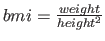
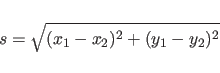
- What would be displayed on screen if you type the following lines of code (this execise should be performed mentally):
  > weight <- c(60, 72, 57, 90, 95, 72)
  > height <- c(1.75, 1.80, 1.65, 1.90, 1.74, 1.91)
  > bmi(weight,height)
- What would be displayed on screen if you type the following lines of code (this execise should be performed mentally):
  > a <- c(TRUE,FALSE,FALSE,TRUE)
  > b <- c(FALSE,FALSE,TRUE,TRUE)
  > b|a
  > a&!b
- Given the following assignations:
 > e <- c(1,2,3,5,8,13,21,34,55)
 > f <- c(4,6,7,9)
 > g <- rep("hello",10)
 > h <- 50:60
What would be displayed on screen if you type the following lines of code (this execise should be performed mentally):
 > e[5]
 > e[6:9]
 > h[f[1:3]]
 > e[f-2]
 > g[e[f-3]]
 > c(e,f)
 > f[c(TRUE,FALSE,TRUE,FALSE)]
 > f > 7
 > f[f > 6]
 > f[-2]
 > h[-c(4,6)]
- Given two vectors
 and
and  , write the code allowing to display the elements of in the order given by .
Example
DAT: 9 6 8 2
POS: 2 4 3 1
returns
 .
.
- Write a code that performs the scalar product of two vectors (
 ) given that the formula for vectors of length
  is :
is :
You may use the function  .
.
 and
and  .
.