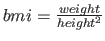
- Que s'affiche-t-il lorsqu'on écrit les lignes suivantes:
  > weight <- c(60, 72, 57, 90, 95, 72)
  > height <- c(1.75, 1.80, 1.65, 1.90, 1.74, 1.91)
  > bmi(weight,height) # cf exercice bmi de la section précédente
- Que s'affiche-t-il lorsqu'on écrit les lignes suivantes:
  > a <- c(TRUE,FALSE,FALSE,TRUE)
  > b <- c(FALSE,FALSE,TRUE,TRUE)
  > b|a
  > a&!b
- Soit les assignations suivantes:
 > e <- c(1,2,3,5,8,13,21,34,55)
 > f <- c(4,6,7,9)
 > g <- rep("hello",10)
 > h <- 50:60
Que s'affiche t'il après chacune de ces lignes?
 > e[5]
 > e[6:9]
 > h[f[1:3]]
 > e[f-2]
 > g[e[f-3]]
 > c(e,f)
 > f[c(TRUE,FALSE,TRUE,FALSE)]
 > f > 7
 > f[f > 6]
 > f[-2]
 > h[-c(4,6)]
- Soient deux vecteurs
 et
et  de longueur
  .
Écrire un extrait de code qui affiche les éléments de dans
l'ordre indiqué par (qui contient les entiers de 1 à ).
.
Écrire un extrait de code qui affiche les éléments de dans
l'ordre indiqué par (qui contient les entiers de 1 à ).
Exemple ( )
)
DON: 9 6 8 2
POS: 2 4 3 1
donne
 .
.
- Écrire un extrait de code qui calcule le produit
scalaire de deux vecteurs (
 ) de longueur :
Vous pouvez utiliser la fonction  .
.
 et
et  , c'est-à-dire qu'après exécution de ces lignes, la variable